

As solar energy has gained popularity, more and more individuals are choosing to purchase solar streetlights for use in their own garden communities. The general public, however, may not fully comprehend the solar street light's operating principle, which might lead to certain erroneous assumptions being made during the application process. The list of typical solar street light application issues is provided below for sharing and dialogue.
1. When installed, the panels are exposed to as much natural light as possible.
Solar energy is used to power solar street lights, thus it is important to make sure that sunlight shines on the solar panel in order for the kinetic energy to be captured and the lighting system to be powered. Avoid using shades and keep the solar lights as widely apart as you can. The wattage of the solar lights may be used to specify the precise spacing. For instance, the typical garden lamp has a height of 3.5 meters, a light output of 15 to 30 watts, and a spacing of 8 to 15 meters.
2. Solar panel if there is a protective film to remove
The protective film covering the solar panel must be removed; otherwise, the solar panel's ability to digest and absorb natural light would be significantly reduced. This is a point that many customers find extremely easy to overlook.
3. The cable between the lamp holder and the panel cannot be connected inversely
The lighting fixture won't switch on if the solar panel is attached to the lamp head backward or the interface is loose because the transmission of energy from the solar panel to the rechargeable battery in the lighting fixture is not possible.
4. Regularly clean
Around three months are needed to clean the solar panel's surface of dead leaves, dust, and debris. When the solar panel is covered, the absorption efficiency is significantly reduced, and the solar panel may potentially be harmed. But now that automated cleaning, disinfection, and dust removal technology for solar panels has emerged, it has the potential to significantly increase solar energy conversion rates and prevent the prevalent spot effect.
5. Solar products preferentially choose the light control switch process
The controller's influence in the particular application is not significant, in addition to the installation of adjustment, and many configurations are simply simple to shut off the lights in the midst of delivery. Most configurations are also not utilized, preventing arbitrary adjustment.
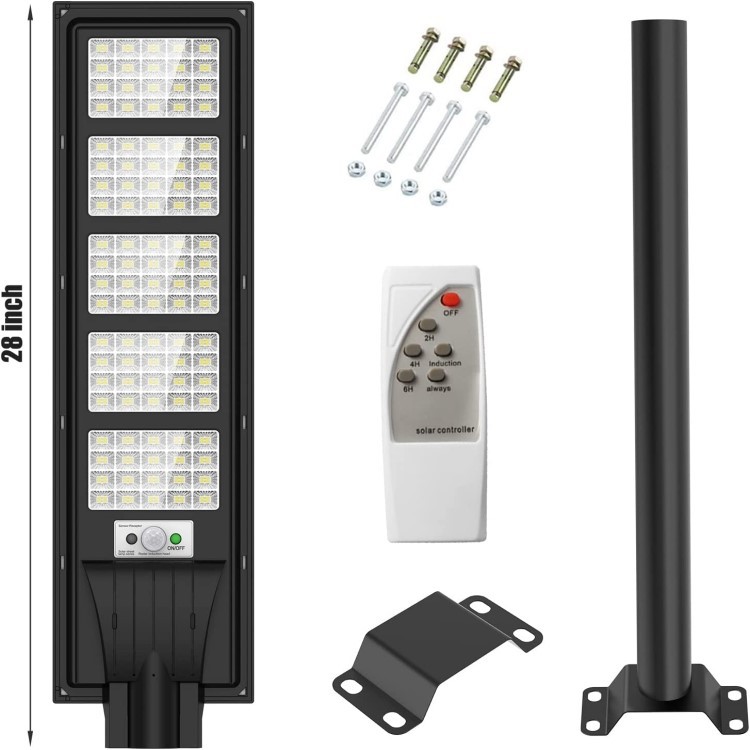

| Watt | 100W/150W/200W/250W/300W |
| Material | Aluminum Alloy |
| Style | Modern |
| IP Grade | IP65/IP67/IP68 Waterproof |
| Specific Uses | Garden, Garage, Yard |
| Indoor/Outdoor Usage | Outdoor |
| Power Source | Solar_powered |
| Luminous Flux | 100000-120000 Lumen |
| Bulb Features | Dimmable |
| Color Temperature | 3000k, 4000k, 5000k, 6000k |
| Color Rendering Index (CRI) | 82-90ra |
| Lifespan | 50000 Hours |


